
Criminal Cases in the Ascension Parish Courts
The 23rd Judicial District Court has original jurisdiction over felony prosecutions in Ascension Parish. Although the district also spans Assumption and St. James parishes, the Ascension Clerk remains custodian of Ascension Parish criminal case records. District divisions sit through the Gonzales and Donaldsonville courthouse system. A prosecution generally begins with a bill of information filed by the district attorney or an indictment returned by a grand jury. The docket number, division, and caption connect later pleadings, hearings, minutes, and the disposition.
Lower-level records can live elsewhere. Ascension Parish Court has separate statutory jurisdiction over parish misdemeanor and traffic matters. Gonzales City Court, Donaldsonville Municipal Court, and Sorrento Mayor's Court keep their own local dockets. A failed 23rd JDC search therefore does not prove that no case exists.
Which Ascension Court Has It?
Jurisdiction determines the custodian. Start with the district clerk for felony filings and broader district criminal matters. Parish Court maintains its limited-jurisdiction docket, while each incorporated municipality routes ordinance and traffic matters through its proper court. The issuing court also controls a capias, which is an order to bring a person before that court.
| Court | Location | Typical scope |
|---|---|---|
| 23rd JDC / Ascension Clerk | Gonzales and Donaldsonville | Felony and district criminal files |
| Ascension Parish Court | Gonzales | Parish misdemeanor and traffic matters |
| Gonzales City Court | Gonzales | City-court cases |
| Donaldsonville Municipal Court | Donaldsonville | Municipal ordinance and traffic matters |
| Sorrento Mayor's Court | Sorrento | Mayor's-court matters |
How to Search Case Records
Ascension Clerk remote access is a subscription service, not an anonymous statewide search. The published agreement claims criminal-index coverage from November 1986 forward and images from 2000 forward. The clerk warns that indexing can lag after an official number is assigned and that the online version is not the official record. A docket number is the best key. Otherwise, provide the defendant name and approximate filing year.
- Identify whether the matter belongs to 23rd JDC, Parish Court, or a municipal or mayor's court.
- Use Clerk remote access if subscribed, or contact the correct clerk counter.
- Search by docket number, or supply defendant name and approximate filing year.
- Read entries in date order and match every charge to its disposition.
- Request the exact filing, certified docket, or certified disposition needed.
| Field Label | Type | Required | Notes |
|---|---|---|---|
| Defendant name | Text | Not verified | Expected key behind the login gate |
| Case number | Text | Not verified | Best identifier for one file |
| Filing date or year | Date | Not verified | Narrows common names |
| Record type | Select | Not verified | Choose criminal if offered |
| Division | Index value | Not verified | Confirm against the docket |
Ascension Clerk Remote Access
The official Clerk remote-access gateway requires a username and password. Its published agreement lists a $100 nonrefundable setup for one login, $250 for up to five logins plus $20 for each additional login, $50 monthly, and $0.50 per printed page. It lists a $300 advance for out-of-state customers. Because the agreement uses dated hardware language, confirm all terms before subscribing.
The official Ascension Clerk remote-access gateway is shown in the manifest image.
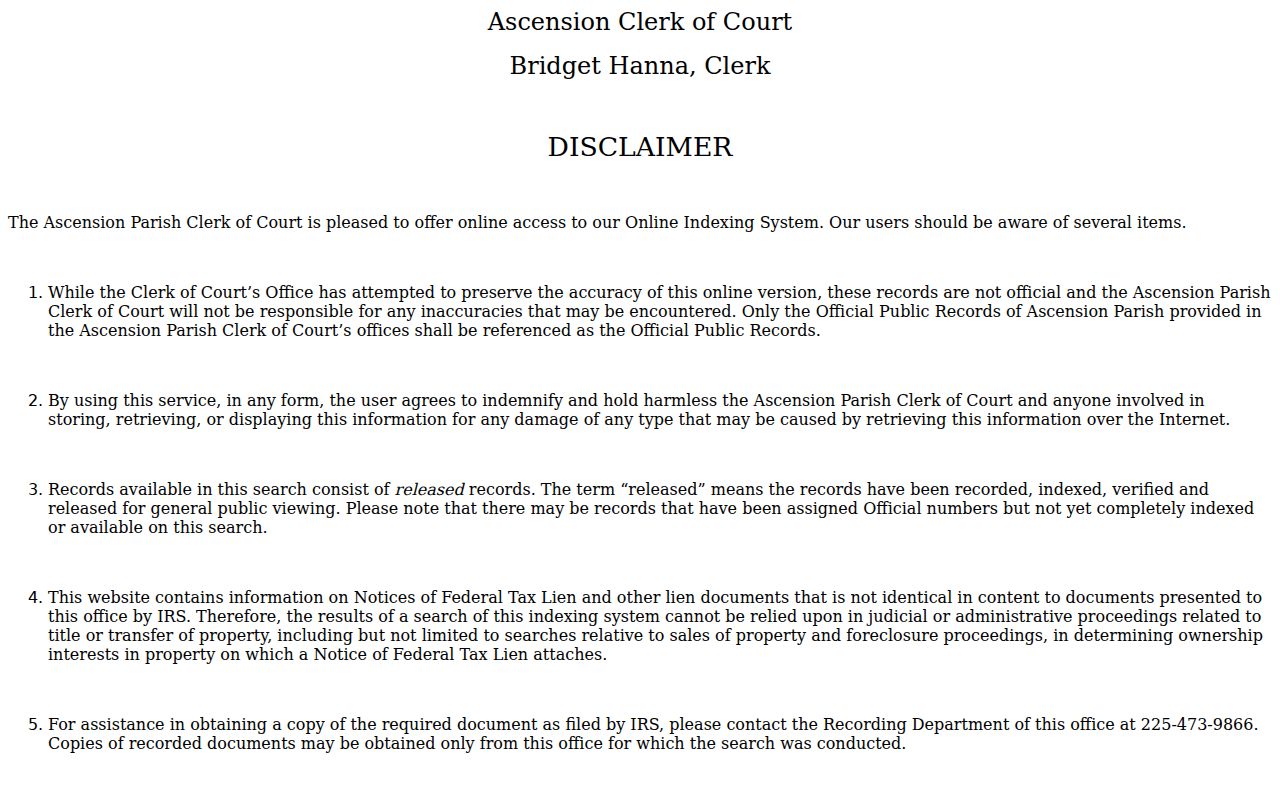
Its warning explains why a missing online result is not conclusive: indexing can lag, and the display is not the official record.
What the Case File Shows
An Ascension Parish criminal case file records the prosecution rather than merely the arrest. Get the docket first because it provides the chronological spine. Then request the charging instrument, minutes, plea or verdict, judgment, and sentence needed to answer the question. A bill of information is filed by the district attorney. An indictment is returned by a grand jury. Neither alone proves guilt.
| Case Number & Court | Docket number, caption, division, judge, and filing date identify the file. |
|---|---|
| Charging Document | Complaint, information, or indictment states filed charges. |
| Docket Entries | Minutes track counsel, bond, capias, motions, and settings. |
| Hearing Dates | Arraignment, motion, plea, trial, and sentencing settings. |
| Disposition & Judgment | Dismissal, nolle prosequi, acquittal, plea, or verdict for each count. |
| Sentence & Conditions | Custody, suspended time, probation, fines, costs, restitution, and appeal. |
Reading Ascension Court Outcomes
A booking charge can be refused, amended, divided into counts, or replaced. “Nolle prosequi” means the prosecutor formally chose not to continue a charge. “Dismissed” also ends a charge without conviction, while “not guilty” is an acquittal. “Guilty as charged” and “guilty to amended charge” describe different results. Read every count rather than reducing the file to a record-found label.
- Arraignment
- The hearing where the charge is read and a plea is entered.
- Disposition
- The final outcome of a charge.
- Capias
- A court command to bring a person before it.
- Recognizance
- Release on a promise and conditions instead of secured money.
- Expungement
- Removal of qualifying information from public access, not destruction.
Stages of a Criminal Case
A matter may begin with arrest or summons, but prosecutor screening controls whether and how a district charge is filed. Information or indictment is followed by arraignment, discovery, motions, and plea or trial. The court records the disposition and, after conviction, the sentence. An appeal can create a later record. Timing varies with motions, charge complexity, and court settings.
Case flow: Charges Filed › Arraignment › Pretrial › Plea or Trial › Disposition › Sentencing
Certified Ascension Court Dispositions
For older files, missing images, or proof of outcome, give the Ascension Clerk the defendant name, approximate filing year, and docket number if known. Specify a certified docket, disposition, judgment, or charging instrument. Ask whether archive retrieval is needed and request current copy and certification charges because those counter fees were not located in reviewed official sources.
Ascension Clerk of Court
828 S. Irma Blvd.
Gonzales, LA 70737
225-621-8400
Donaldsonville Counter
300 Houmas St.
Donaldsonville, LA 70346
Call the clerk for current service details.
When Ascension Search Has No Result
First check whether the event belongs to Parish Court or a municipal or mayor's court rather than 23rd JDC. Next consider the published index start date, missing pre-2000 images, and the clerk's warning that an official number may exist before complete indexing. For a recent matter, allow for filing and indexing time without assuming an outcome. For an older matter, request an archive search using the defendant name and approximate year.
A no-result screen is not a disposition. Only a clerk-confirmed file, certified outcome, or clear explanation that the queried court has no responsive record can answer the question for that court. Retain the search terms, date, and court contacted so a later inquiry can be compared with the earlier response. Ask whether alternate spellings or a known docket number would improve the clerk's search.
When requesting a complete Ascension Parish criminal case record, name the instruments rather than asking only for “the file.” Useful items include the docket sheet, bill of information or indictment, arraignment minutes, motion rulings, plea minutes, judgment, sentence, and notice of appeal. Ask whether images are available remotely or only at the counter. Date of birth, home address, Social Security number, victim and minor identities, and sealed exhibits may be removed from the copy. A redaction does not make the remaining public portion unreliable; it limits disclosure of protected data while preserving the procedural history. Record the clerk source and date.
Access & Restrictions
Louisiana Public Records Law broadly defines public documentary material, subject to exceptions and court orders. Juvenile identities, protected victim data, personal identifiers, sealed exhibits, and grand-jury material may be confidential or redacted. An omission can also result from date coverage, indexing delay, a separate lower court, or expungement.
The Clerk, not APSO, holds the court file. If an online view is incomplete, ask whether a paper file, archive, or segregable public portion exists. Compare allegations against the separate Ascension Parish arrest history record.